In short
Every empty token account holds a refundable SOL deposit, and closing it returns all of it. Older accounts hold about 0.00204 SOL each. Solana's SIMD-0437 cut lowers that for new accounts but doesn't take anything from old ones. Work out your own total with the calculator below.
On this page
If you've traded on Solana for a while, you probably have SOL sitting in accounts you've forgotten about. It isn't lost, and you can get it back. I built the SOL Reclaimer in SolTools to do exactly that, so here's how it works underneath.
What rent actually is
Everything on Solana lives in an account, and accounts take up space on every validator. To pay for that, each account has to hold a minimum balance of SOL, called its rent-exempt minimum.
The word "rent" is misleading. It's closer to a refundable deposit. It isn't charged over time, and you get it back in full when the account closes.
The minimum depends on the account's size:
minimum = (128 + data size in bytes) × lamports per byte
The 128 is a fixed overhead for every account. One SOL is 1,000,000,000 lamports.
Where your SOL gets stuck
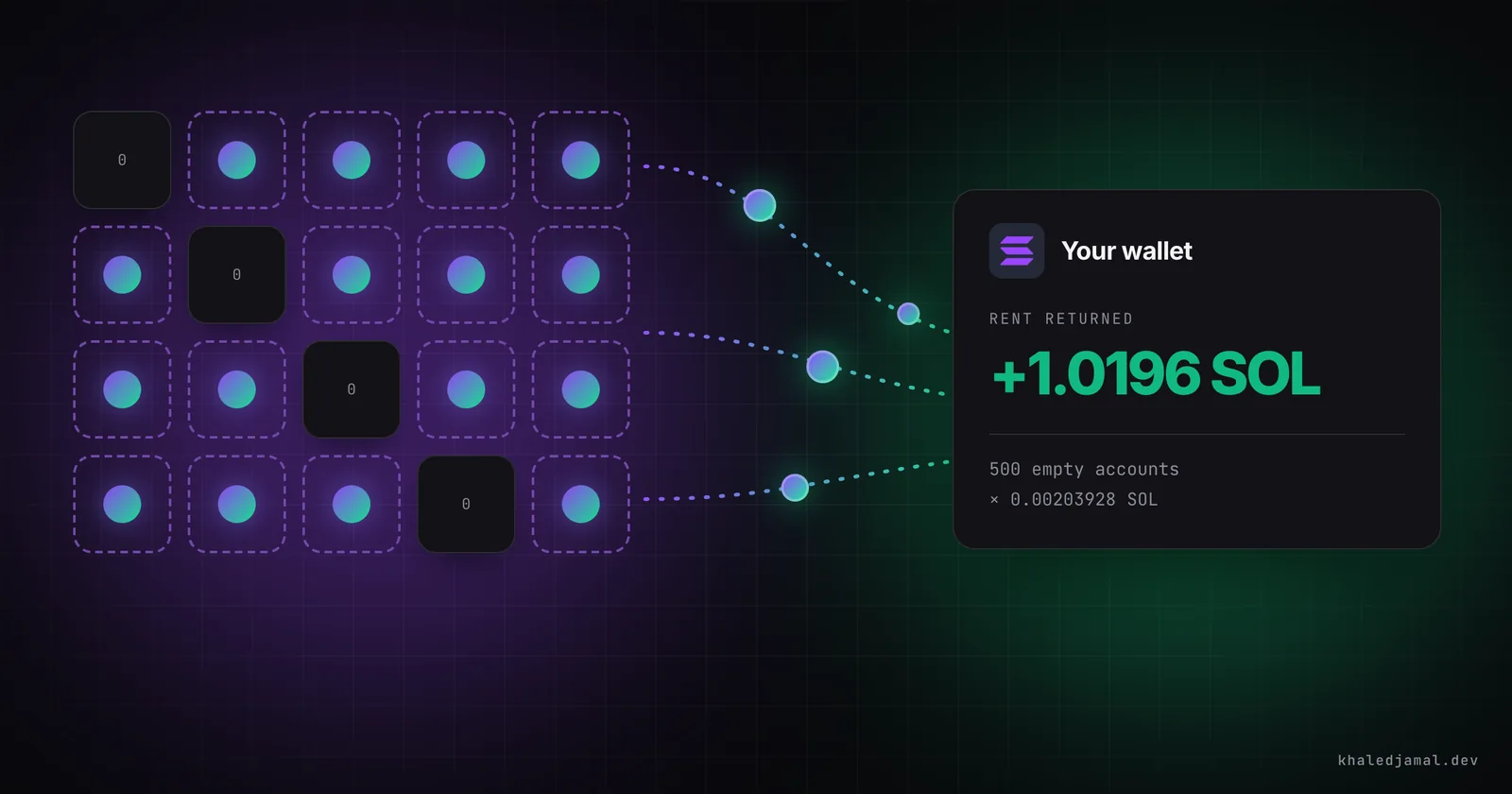
Every token you hold sits in its own token account, separate from your main wallet. A standard SPL token account is 165 bytes. At the long-standing rate of 6,960 lamports per byte, that's:
(128 + 165) × 6,960 = 2,039,280 lamports = 0.00203928 SOL
That's the small amount your wallet deducted each time you first received a token.
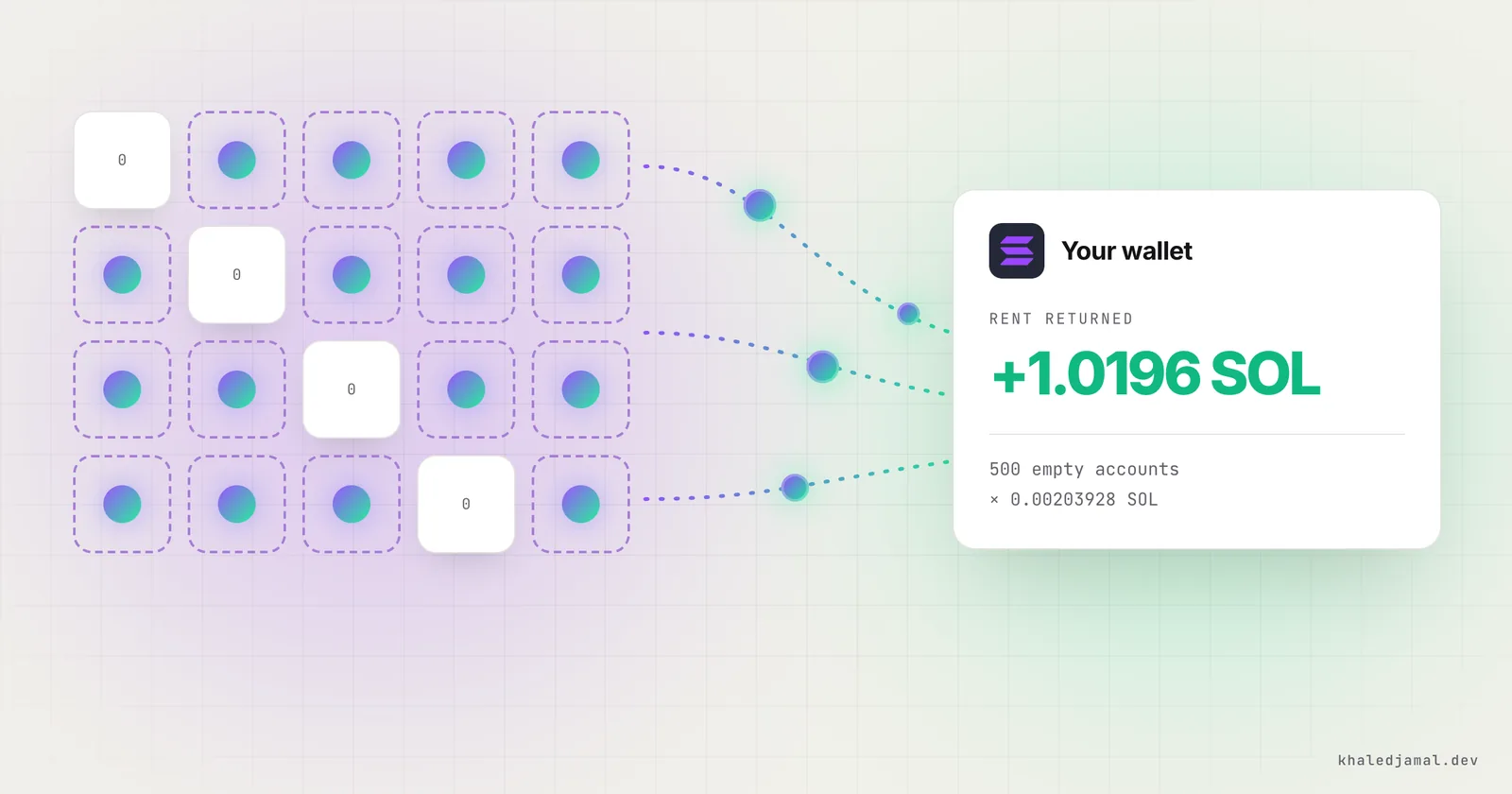
When you sell all of a token, the balance goes to zero, but the account usually stays open, and the deposit stays inside it. Trade a few hundred memecoins and it adds up: 500 empty accounts at that rate hold over a full SOL.
Calculator
How much SOL is sitting in your empty accounts?
Count them in any wallet tracker or scan with a reclaimer. This assumes standard 165-byte SPL token accounts.
When were most of them opened?
You'd get back
0.305842 SOL
- Rent held
- 0.305892 SOL
- Network fees, 10 tx
- ≈ 0.00005 SOL
- Excess if kept open
- 0.082626 SOL
An estimate. Fees assume 15 closes per transaction at the base fee, without priority fees. Token-2022 accounts can be larger, and accounts holding dust have to be emptied first.
How closing an account works
The SPL Token program has a CloseAccount instruction. It does three things:
- Checks that the token balance is zero
- Sends the account's SOL to a destination you choose
- Removes the account
Only the account's owner, or a close authority if one has been set, can sign it. This is why a reclaimer tool doesn't need your keys. It builds the transaction, and your wallet signs it.
You pay normal network fees for the transaction, which are tiny next to what comes back. Several closes fit in one transaction, and the SOL Reclaimer batches up to 15 accounts at a time.
What about accounts with dust?
An account holding even a tiny amount of a token can't be closed. You have to empty it first, either by selling or by burning the tokens. Burning is permanent, so make sure it really is worthless before you do it.
What SIMD-0437 changes
This is where most guides are now out of date. SIMD-0437 is cutting Solana's rent rate by 90%, from 6,960 to 696 lamports per byte, in five steps. The first two went live on mainnet in September 2026, with the rest expected to follow.
For a 165-byte token account, the minimum changes like this:
| Rate (lamports per byte) | Minimum (lamports) | In SOL |
|---|---|---|
| 6,960 (original) | 2,039,280 | 0.00203928 |
| 5,080 (step 2) | 1,488,440 | 0.00148844 |
| 696 (final step) | 203,928 | 0.000203928 |
Two things follow from this:
- Old accounts keep their full deposit. The cut moves no SOL. An account opened at the old rate still holds about 0.00204 SOL, and closing it still returns all of it.
- New accounts lock up less. So a wallet with many recent accounts has less to reclaim than the old figure suggests.
The schedule can change, so don't hardcode these numbers. Read the live value with the getMinimumBalanceForRentExemption RPC method.
A new option: taking the excess without closing
Because old accounts now hold more than the new minimum, there's a second route. The WithdrawExcessLamports instruction, available in both SPL Token and Token-2022, withdraws only what's above the current minimum. The account stays open, and its token balance isn't touched.
That's useful for tokens you're still holding. The exception is wrapped SOL accounts, which don't support this instruction and have to be closed instead.
Will closing hurt anything?
Generally not. If you later receive that token again, a new account is opened and the deposit is paid again, at the rate at that time. If you trade a token constantly, you may prefer to leave its account open.
Staying safe
This is a popular area for scams, because you're being asked to sign a transaction. Whichever tool you use:
- Never share your seed phrase or private key. Closing accounts never needs them.
- Read what your wallet shows before you sign. A close should bring SOL to you, and nothing else should leave.
- Be careful with fees. Many reclaimers keep a cut of what you recover, so check what it is.
- Use a tool you can verify. A drainer can look exactly like a reclaimer.
SolTools' reclaimer is free, with zero fees, and runs in your browser, so your keys never leave it. Try it at soltools.net/reclaim.
Rate figures are from the Chainstack and Raydium documentation on SIMD-0437, checked in November 2026.
Written by Khaled Jamal
Software engineer in Beirut, known online as Dequavious, and founder of Helm. I build SaaS platforms, AI agents, desktop apps and client sites end to end.